There is a version of the McLaren Solus GT that exists only in data. It has no weight, no heat, no smell of hot carbon and race fuel. It cannot bruise your ribs through a corner or leave your palms damp after a searing lap.
That version — designed for a Gran Turismo video game in 2017 — was, by most definitions, enough. An extraordinary digital object, fawned over by millions, and then filed away as a piece of inspired design.
McLaren, to their enduring credit, decided that was not enough. The result is the Solus GT: 25 physical machines, each one a direct descendant of that digital dream, and collectively one of the most uncompromising things that any car manufacturer has put its name to in the modern era.
In this article:
- From Screen to Silverstone
- A Design With No Compromise and No Apology
- Ready for Take-off
- 829bhp and a 10,000rpm Redline
- A Driving Experience from a Different Planet
- Beyond the Road
- Frequently Asked Questions
From Screen to Silverstone

The McLaren Solus GT traces its roots back to a design project that Rob Melville, McLaren's design director, began sketching as far back as 2010 — a personal vision for the most extreme McLaren imaginable, unconstrained by regulation or road use.
That vision found its first public expression in 2017, when it was adapted into the Ultimate Vision Gran Turismo concept for Sony's celebrated racing simulation, Gran Turismo Sport.
It appeared as a single-seat, jet-inspired machine so extreme that the driver was required to lie in a near-prone position. It was, in gaming terms, a fantasy. In engineering terms, it was an irresistible challenge.
McLaren's team of engineers and designers took the concept and asked a serious question: how much of this could actually be built? The answer, it turned out, was most of it.
The prone driving position gave way to a conventional (if still ferociously snug) single seat, but the spirit of the original was preserved in almost every other respect. Physical production was handed to KW Special Projects in Silverstone — not McLaren's Woking headquarters — a detail that underlines just how bespoke and craft-intensive the Solus GT programme truly was.
A Design With No Compromise and No Apology
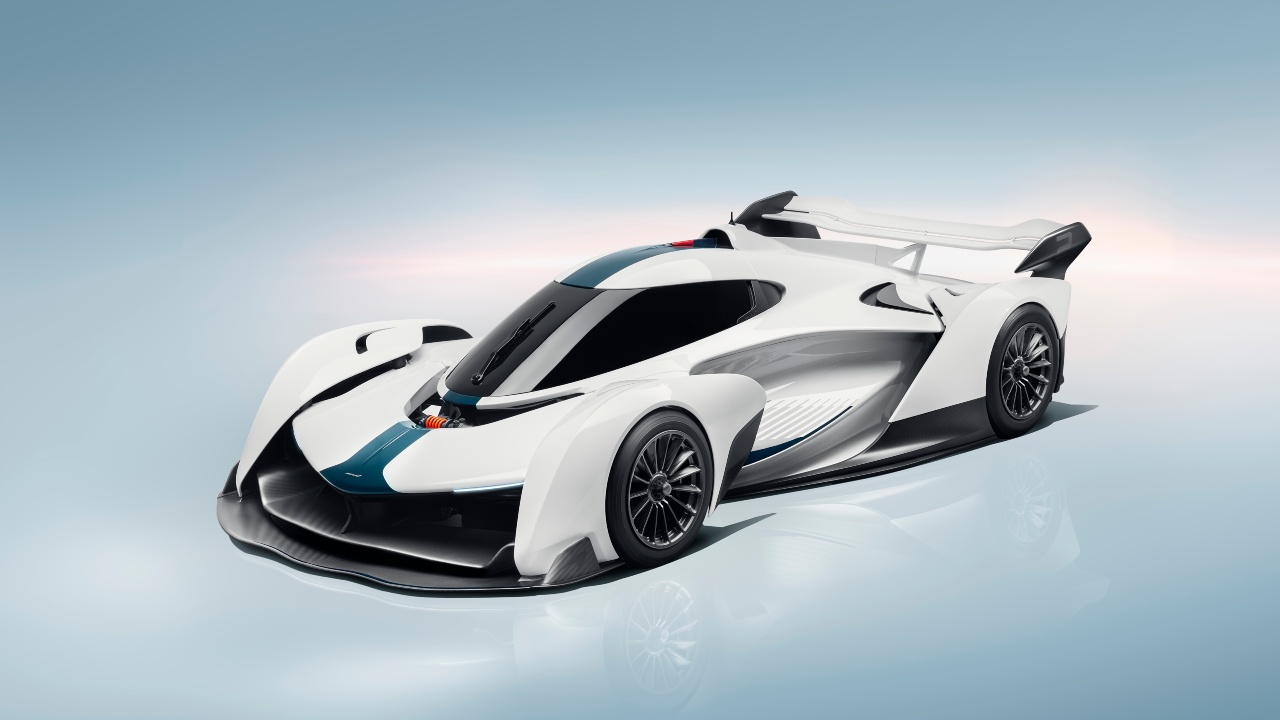
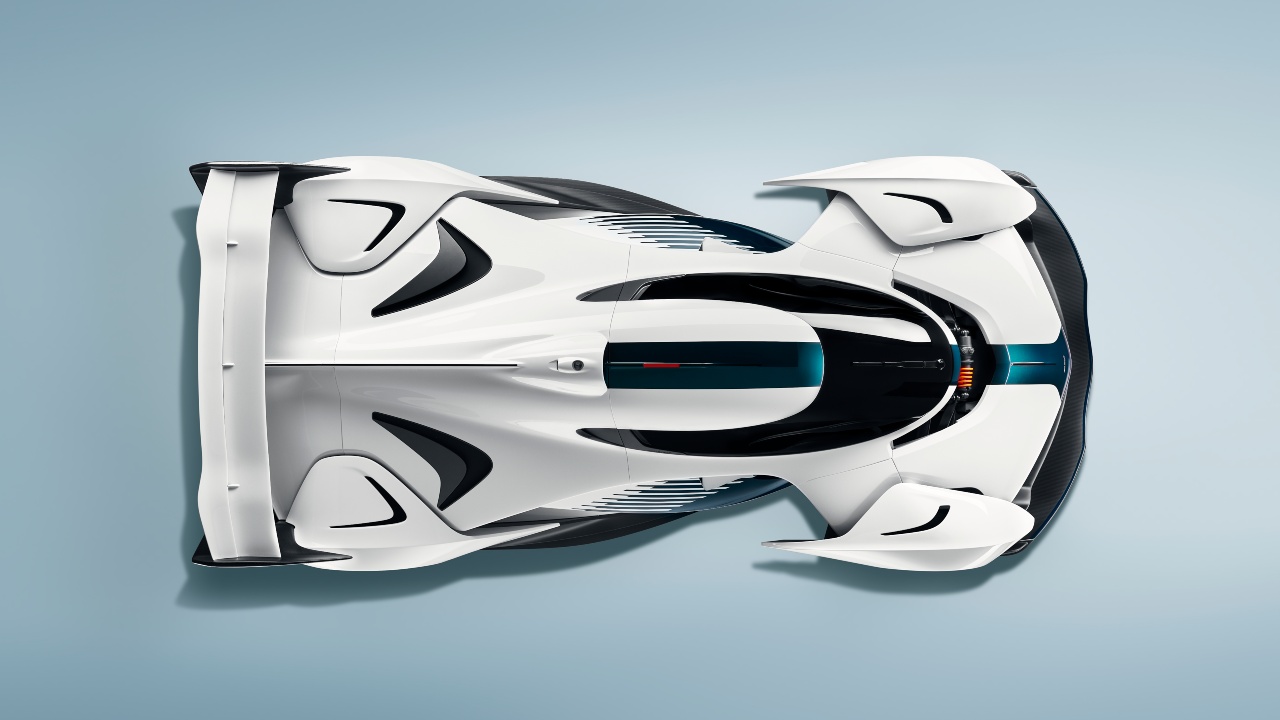
To describe the Solus GT as a striking-looking car would be an act of considerable understatement. It is a vehicle that appears to have arrived from a different timeline. The enclosed single-seat canopy, which rises and tilts forward to allow entry, gives the car the profile of a ground-hugging fighter aircraft. The body, constructed entirely from carbon fibre, is drawn tight around it like a second skin.
The aero package is extraordinary even by the standards of cars that never make it onto the road. At top speed, the Solus GT generates up to 1,200kg of downforce — more than its own weight.
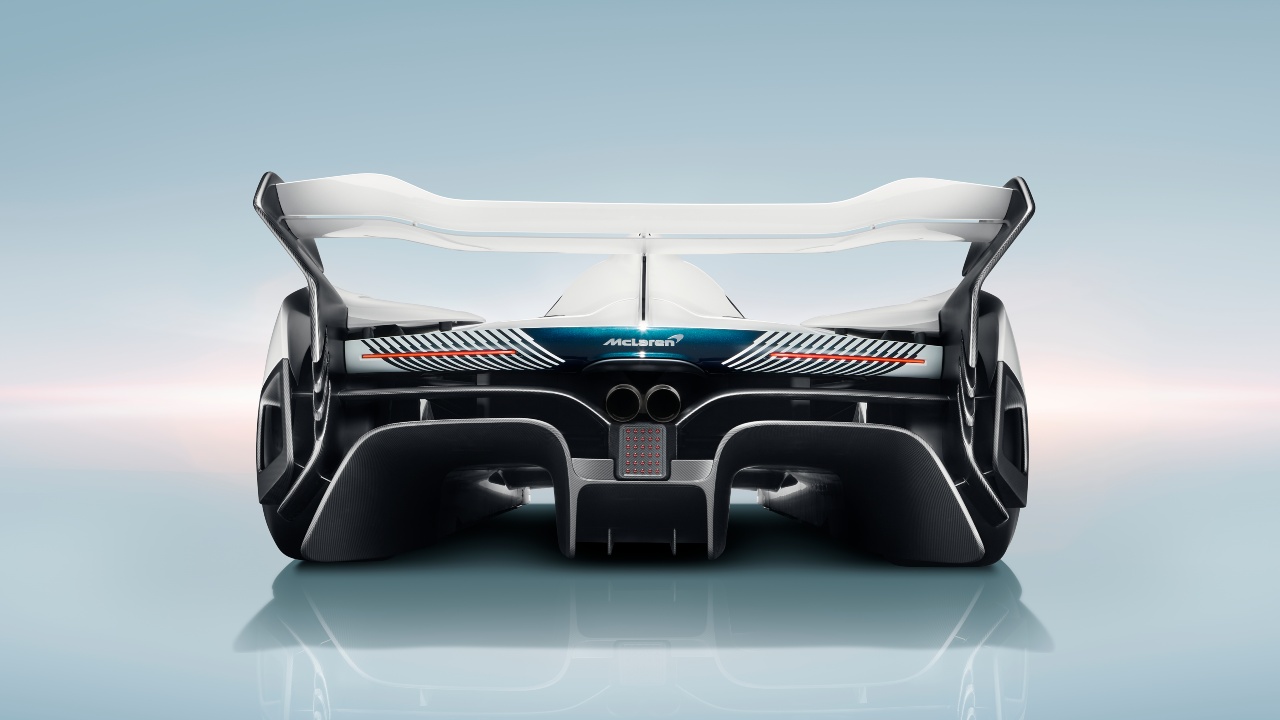
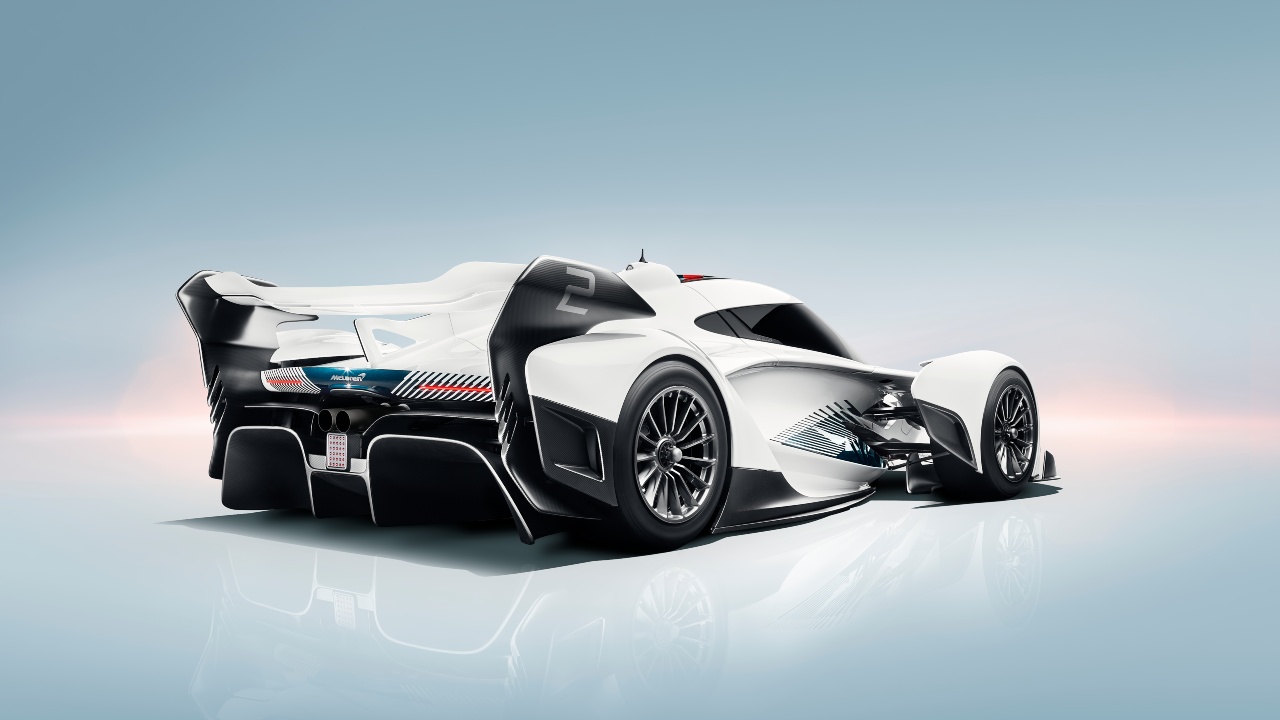
Every element of the bodywork, from the dramatic front splitter to the rear diffuser and the towering twin-element rear wing, exists as part of an integrated aerodynamic system. Even the individual wheel pods — teardrop-shaped fairings that enclose each wheel and tame the turbulent air in their wake — serve a precise aerodynamic purpose. There is no decorative surfacing here, no design flourish that the wind tunnel hasn't approved.
The cumulative effect is a car that feels resolved from every angle. Aggressive and purposeful from the front, dramatic and mechanical from the rear, and unlike anything else on earth from any angle in between.
The result is a car that is beautiful not despite its function, but entirely because of it — in the same tradition as McLaren's F1 and the iconic Can-Am racers that originally inspired Rob Melville's brief.
Ready for Take-Off
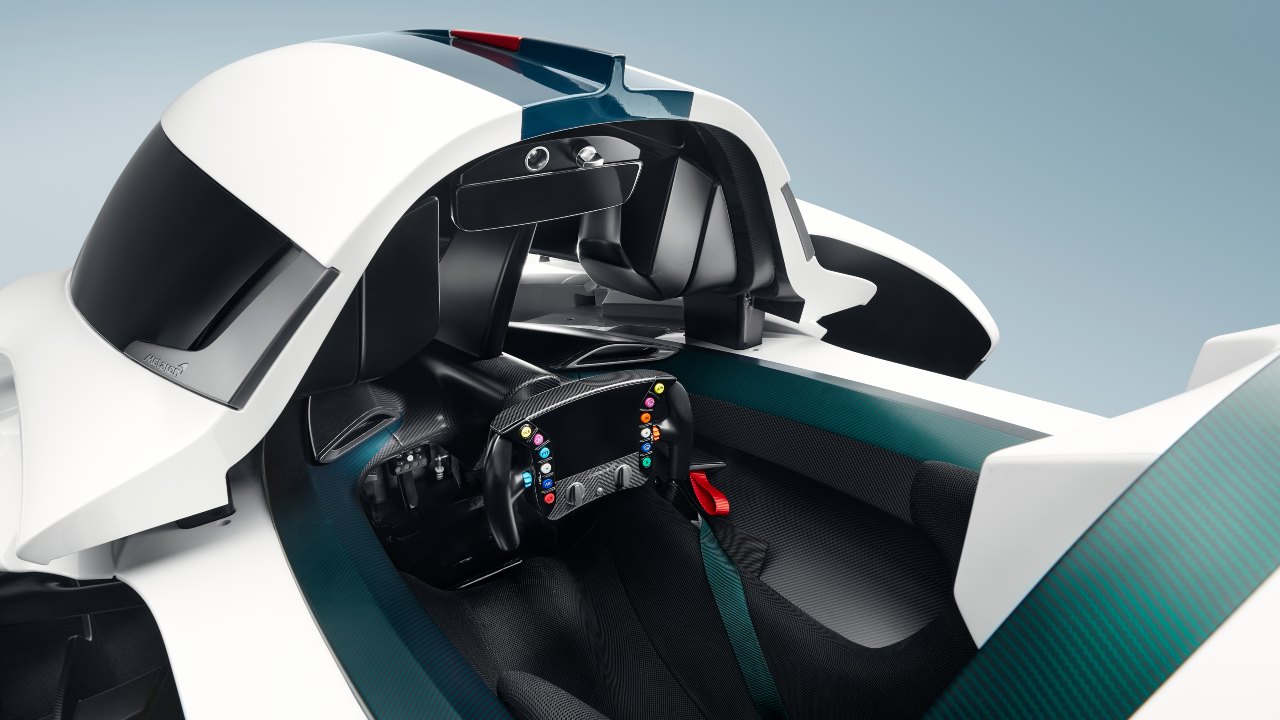
Entering the Solus GT is an event in itself, and the process requires some commitment. The canopy hinges forward and upward, and the driver descends into a cockpit that has been carved around them — quite literally, in fact, since every Solus GT is delivered with a carbon fibre seat custom-moulded to the measurements of its owner. There is no adjustability for anyone else. This is not a car that accommodates passengers, well-wishers or second opinions.
Once settled, the view from behind the wheel is one of focused minimalism. The instruments are purposeful, the controls uncluttered — and the steering wheel itself is directly derived from the Formula 1 wheel used by Lando Norris, a detail that leaves no doubt about the company McLaren intended the Solus GT to keep. A halo-style roll structure, fabricated from 3D-printed titanium, frames the overhead view, while the FIA-specification six-point harness holds the driver firmly within their moulded seat.
McLaren equips each car with a matched FIA race suit, helmet, and HANS device, because the Solus GT treats its driver as an active component of the machine. Every sensory input is heightened. Every distraction has been deliberately removed.
829bhp and a 10,000rpm Redline
The engine at the heart of the Solus GT is worth dwelling on. McLaren turned to Judd, the British motorsport engine specialists, to develop a naturally aspirated 5.2-litre V10 that produces 829bhp and revs beyond 10,000rpm — and that figure climbs to 858bhp at speed, as ram air forces additional charge into the engine the faster it goes. It covers 0 to 62mph in around 2.5 seconds, and it is a powertrain that rewards momentum. But numbers alone do not define this exceptional machine.
In an era when forced induction has become the default solution for chasing ever-higher power figures, the decision to build a free-breathing V10 is a deliberate one. There are no turbochargers here, muting the relationship between throttle input and engine response. What you ask for is what you get, immediately.
The engine also acts as a structural member of the chassis — a technique borrowed from Formula 1 that eliminates redundant framework and keeps mass tightly centralised. Drive goes through a sequential gearbox, and the camshafts are gear-driven rather than chain or belt-operated, producing a sound that, at high revs, is said to be unlike almost anything else on four wheels.
Combined with a dry weight of just 935kg, the performance figures begin to feel less like statistics and more like inevitabilities.
A Driving Experience From a Different Planet
Bruno Senna, who served as development driver for the Solus GT, chose his words carefully when asked to describe what it is like to drive. He described it as 'a whole different planet' compared to other McLaren models.
The suspension is Formula 1-derived, using pushrod geometry at both ends, and the car runs on Goodyear slick tyres built to LMP2 specification and developed specifically for the programme. Downforce is the defining characteristic. At speed, the car generates immense aerodynamic grip, effectively pressing itself into the track.
Corners that would be taken gingerly in any other context become anchored, assured, precise. Despite all of this ferocity, the Solus GT is not entirely unforgiving. ABS and traction control are fitted, and four configurable drive modes allow owners to progressively explore the car's capabilities.
At Goodwood in 2023, a Solus GT driven by Marvin Kirchhöfer completed the Festival of Speed hillclimb in 45.34 seconds, making it the third fastest production car ever to tackle the famous course. Even at an event defined by extraordinary machines, it stood apart.
Perhaps the single most striking aspect of the driving experience is the sense of immersion. With no passenger, no distractions and a cockpit designed entirely around the driver, the sensations are intensely personal. It is not just about speed. It is about connection — the feeling of being fully engaged with the machine at every moment.
Beyond the Road
To understand the place the Solus GT occupies within McLaren, it helps to trace the line from which it descends. The Ultimate Series — the designation McLaren reserves for its most extreme and limited creations — began with the legendary F1 of the 1990s and continued through the hybrid P1, the visceral Senna, the elegant Speedtail and the open-air Elva. Each of these cars pushed further into territory that road cars conventionally avoid.
The Solus GT is the point at which that journey leaves the road entirely. Where its predecessors in the Ultimate Series made concessions to road legality, to weather and to the requirement that the driver must occasionally stop for fuel in a public place, the Solus GT makes none.
This is a track-only machine that exists entirely within the boundaries of the circuit and entirely on its own terms. It is, in that respect, the logical destination of everything McLaren has been working towards since Ron Dennis commissioned Gordon Murray to build something that had never been built before.
Frequently Asked Questions
Production was limited to exactly 25 examples — a number that reflects the sheer complexity and craft involved in building each one. With every car custom-moulded to its owner's measurements, the Solus GT is, in a meaningful sense, 25 distinct objects rather than 25 identical ones. For owners, it is not just about rarity, but about being part of a very small group connected by a shared passion for extreme engineering.
The Solus GT carried a price of approximately £3 million before taxes at the time of its release — a figure that needs some context to fully appreciate. Buyers received not merely a car, but a complete programme: bespoke to its owner in every respect, from the moulded seat to the matched race kit and a full driver development and track support package. Despite the eye-watering price tag, all 25 examples were sold before the car was even publicly revealed at Monterey Car Week in August 2022.
McLaren quotes a top speed in excess of 200mph, though the more telling figure for a car like the Solus GT is arguably not its straight-line velocity but its corner speed — the rate at which that 1,200kg of downforce allows it to carry pace through bends that would unsettle any conventional car. The 0 to 62mph time of 2.5 seconds gives a clearer sense of the car's character: it is a machine built for the rhythm of a circuit, for the interplay of braking, loading and acceleration.
No — and that is entirely by design. The Solus GT is a track-only machine, and unlike rivals such as the Aston Martin Vulcan, which had one example converted to road-legal specification by a third party, no road conversion exists for the Solus GT. It was designed from the outset without any concession to the requirements of public road use — no lights, no numberplate provisions, no weather protection, no nod whatsoever to the kind of compromises that road cars require. This is not a limitation of the Solus GT so much as a declaration of intent.
Experience McLaren with Stratstone
The Solus GT occupies a place in McLaren's history that is unlikely to be revisited — a singular moment when a digital dream was made physical in the most uncompromising way imaginable. All 25 examples now belong in private collections around the world, making it one of the most exclusive machines to bear the McLaren name.
While the Solus GT may be beyond reach, McLaren's broader range continues to deliver some of the most thrilling driving experiences available on four wheels. As an authorised McLaren retailer, Stratstone is here to help you explore what the brand has to offer — from the latest models to carefully selected pre-owned examples. Get in touch with your nearest Stratstone McLaren retailer to find out more.